
Blog
Acro Yoga vs Partner Yoga: What's the Difference?
People often use "acro yoga" and "partner yoga" as if they meant the same thing. They overlap, and we teach elements of both, but they have different goals, different roles and very different learning curves.
The short answer
Partner yoga is any yoga practiced with another person. It usually stays close to the ground and focuses on assisted stretching, balance, breath and connection. Acro yoga is a specific blend of acrobatics, yoga and healing arts in which one person lifts and balances another in the air. All acro yoga is partner yoga, but most partner yoga is not acro yoga.
Side by side
| Partner yoga | Acro yoga | |
|---|---|---|
| Main goal | Shared stretching, balance and connection | Balancing one partner in the air, from static poses to flowing transitions |
| Roles | Two equal partners who often swap within a pose | Base, flyer and spotter |
| Where you are | Mostly seated, kneeling, standing or lying down | Flyer off the ground, base usually on the back |
| Typical poses | Back-to-back twist, seesaw fold, double tree, double boat | Front plank, bird, throne, folded leaf |
| To start, you need | Willingness to communicate | Some strength, body awareness and a trained spotter |
| Learning curve | Gentle; useful from the first session | Steeper; progress comes in stages |
What partner yoga focuses on
In partner yoga the second person acts as a living prop. They give you traction in a forward fold, a counterweight in a balance, or simply a back to lean on while you breathe. The poses are familiar from solo practice, and the challenge is less about strength than about attention: sensing how much support your partner needs and saying clearly what you need. Our post What Is Partner Yoga? covers this in more detail, and Partner Yoga Poses for Beginners gives seven shapes to try.
What acro yoga focuses on
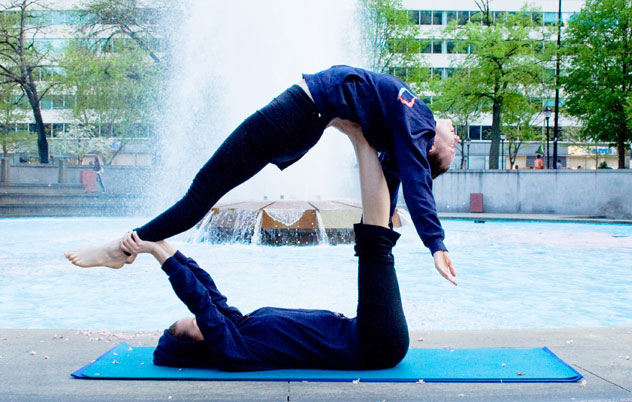
Acro yoga as a named practice grew up in North America around the turn of the millennium, combining acrobatics with yoga and healing arts such as Thai massage. It works with three clear roles:
- Base: usually lies on the back and supports the flyer with the feet and hands, stacking bones over bones so the weight travels into the floor.
- Flyer: the person lifted, who keeps the body engaged and shaped so the base can balance them.
- Spotter: stands close by, watches the pair and protects the flyer's head and shoulders if anything goes wrong.
The acrobatic side builds from static shapes like front plank and bird toward transitions and more advanced standing work. The healing side uses the same lifts in a softer way, letting the flyer relax into inversions and receive massage.
Where they meet: therapeutic flying
Synergy sits between the two. We fly, but the purpose of flying in a Synergy class is healing and play rather than tricks. The base lifts the flyer on the soles of the feet and the flyer is invited to let go: arms dangling, head relaxed, spine hanging long. On our health benefits page we describe this as turning the sand clock upside down. For most of the day the head sits above the heart, and in flight that relationship is reversed for a while.
Flying is one part of a Synergy class, alongside circle work, partner stretching, strengthening and Thai massage. It is also a core module of our teacher training program, where trainees learn how to base, fly and spot safely before they teach it to anyone else.
What a first session looks like
A beginner partner yoga class
You will probably start in a circle, warm up with simple movement and spend most of the session on the floor or standing in pairs: twists, folds, balances and some strengthening. In a Synergy class there may be a short, carefully spotted flying section and a few minutes of Thai massage at the end. Nobody needs to lift anyone they are not comfortable lifting.
A beginner acro yoga class
Expect more time on technique. Bases learn how to stack their legs and arms so the bones carry the weight; flyers learn how to keep their bodies engaged and where to look. Spotters learn where to stand. Most of the class is spent repeating a few foundational shapes, like front plank and bird, getting on and coming down safely. It is satisfying, but it is closer to learning a sport.
A word on size and strength
In both practices, technique matters more than muscle. A smaller person can base a larger one when the legs are stacked well, and a stiff partner can still enjoy a supported stretch. What neither practice tolerates is impatience.
Which should you try first?
"I have never done yoga."
Start with partner yoga. You will learn the vocabulary of shared weight and feedback without needing strength or a spotter.
"I am strong and want a challenge."
Acro yoga will give you one, but a foundation in partner work makes it safer and more enjoyable. Bases who have learned to listen through their feet are much easier to fly with.
"I want something to do with my partner, who is not sporty."
Partner yoga, almost certainly. A first class should leave you both laughing, not sore and frustrated.
"I teach yoga and want new tools."
Both have something to offer. If your interest is in therapeutic touch and community, look at Synergy Workshops and the teacher training.
Safety notes for both
- Practice any lift with a trained teacher and a spotter until you know the pose well.
- Use a soft, flat surface and clear space around you.
- Take off jewelry and watches, and keep nails short.
- Agree on a stop signal and come down slowly, never by dropping.
- Inversions are not right for everyone. If you have high blood pressure, eye conditions such as glaucoma, neck or back problems, or are pregnant, talk to your doctor before flying.
You can watch short clips of Synergy exercises in our video gallery to get a feel for the difference before you try either one.