
Blog
What Is Partner Yoga? Benefits for Two
Partner yoga is yoga practiced with another person: two bodies sharing breath, balance and weight so that each can reach somewhere neither would reach alone. It is the root of everything we teach, so it is the right place to start this blog.
A simple definition
In a solo class you are responsible for your own alignment, and your props are a mat, a strap and a block. In partner yoga a second person becomes your prop, your counterweight and your source of feedback. They hold your wrists so you can lean back further in a stretch, press gently into your lower back in a forward fold, or match your breathing while you sit spine to spine. Poses range from very simple, such as two people sitting back to back, to playful lifts where one partner supports the other off the ground.
Partner yoga is not one fixed style. Teachers draw on classical postures, assisted stretching, massage and, in some schools, acrobatics. Synergy Partner Yoga, which Francisco Morales-Bermudez founded in 2005, weaves together partner stretching, traditional Thai massage, dynamic body conditioning and therapeutic flying, framed by circle work that opens and closes every class. You can read more about those roots on our What is Synergy page.
How it differs from practicing alone
- Shared weight. Instead of a strap or a wall, a partner's body gives you traction or counterbalance. Used well, that makes many stretches gentler and better supported, not more extreme.
- Two kinds of attention. You notice your own body and also the person in front of you. That double focus pulls the mind out of its usual chatter faster than most of us manage on our own.
- Constant communication. Every pose involves asking, adjusting and giving feedback, out loud or through touch.
- Giving as well as receiving. Half the time you are the one supporting, and that often turns out to be one of the most rewarding parts of the practice.
Benefits for two
We are careful about promises here. Partner yoga is not a medical treatment, and how it feels varies from person to person. These are the benefits we see again and again in classes, workshops and trainings.
Physical
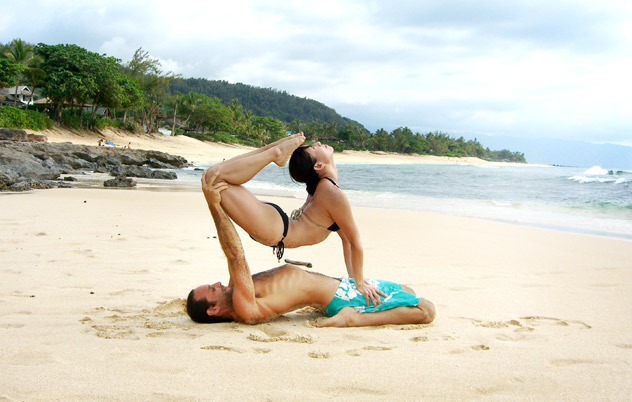
An attentive partner can help you ease into areas that hold a lot of tension, such as the hamstrings, hips, shoulders and the long muscles beside the spine, with more support than you could give yourself. Partner strengthening work, like shared planks, chair poses and balances, asks your core to keep adjusting to a living, moving base. In Synergy we also practice flying, where one partner lifts the other on the soles of their feet. Hanging in a gentle, supported inversion can give the spine a welcome sense of length.
As with any physical practice, talk to your doctor first if you have an injury, a heart or blood pressure condition, or are pregnant, and tell your teacher before class.
Emotional
Play is a big part of partner work, and laughter tends to arrive quickly when two adults try to balance together for the first time. Many people find that the mix of movement, breath and kind, respectful touch leaves them calmer and lighter afterward. Our health benefits page describes how we think about this side of the practice, including why we take play seriously.
Relational
Whether you come with a spouse, a friend, a teenager or the stranger on the next mat, you have to ask for what you need and listen to what the other person needs. Those small, repeated exchanges are why couples, families and teams use partner yoga to reconnect. We look at this more closely in How Partner Yoga Builds Trust and Communication.
Who partner yoga is for
Almost anyone who can get down to the floor and up again can do some form of partner yoga. You do not need to be flexible, and you do not need to bring a partner: in most classes the teacher pairs people up and rotates partners during the session. It suits:
- couples who want time together that does not involve a screen;
- friends and family members, including parents with older kids;
- yoga students who want to explore familiar poses with support;
- yoga teachers, massage therapists and bodyworkers looking for new hands-on tools;
- groups and teams who want a shared experience that is active rather than another meeting.
Children love it too, with a few adjustments. See Synergy Kids for how we work with young people.
Three common myths
"It's only for couples."
Couples do enjoy it, but many of our students come alone and practice with whoever is on the next mat. Working with different bodies, heavier and lighter, stiffer and bendier, teaches you more than always practicing with the same person.
"You have to be flexible."
The less flexible partner often gets the most out of the session, because a patient partner can support them into stretches they would never reach alone. Flexibility is a result of the practice, not an entry requirement.
"It's all acrobatics."
Photos of people balancing on each other's feet travel well online, but most partner yoga happens on the floor: seated twists, assisted folds, shared breathing and massage. Lifts are optional and always taught step by step.
Is it safe?
Partner yoga is generally gentle, and a few habits keep it that way:
- Warm up before deep stretches, balances or lifts.
- Agree on simple words before you start, such as "more," "less" and "stop," and respect them instantly.
- Move slowly into and out of every pose. Never bounce, pull or push suddenly.
- Leave lifts and inversions to classes with a qualified teacher and a spotter.
- Tell your partner and your teacher about injuries, recent surgery or pregnancy, and check with your doctor if you are unsure whether a practice is right for you.
The goal is never to push a partner deeper than they want to go. A good partner pose feels like being held, not like being stretched by someone else's ambition.
How to try it
The easiest way in is a class with an experienced teacher. Our guide to what to expect at your first partner yoga class explains what usually happens in the room, and Partner Yoga Poses for Beginners gives you a few simple shapes to try at home with someone you trust. When you are ready to go further, Synergy Workshops take the practice deeper in a two-and-a-half to three-hour session.
However you begin, start small, laugh often and keep talking. That is most of partner yoga in one sentence.