
Blog
Thai Massage Basics for Partner Yoga Practice
Every Synergy class ends with a few minutes of Thai massage, and it is often the part people remember on the way home. You do not need to be a therapist to give a partner a safe, grounding Thai-style massage, but you do need a few principles.
What Thai massage is
Traditional Thai massage, known in Thailand as nuad Thai, is a hands-on practice given on a floor mat. The receiver stays fully clothed and no oil is used. The giver applies rhythmic pressure with the palms, thumbs, forearms, knees and feet, and moves the receiver through assisted stretches that look a lot like yoga postures. In 2019 UNESCO added Nuad Thai to its Representative List of the Intangible Cultural Heritage of Humanity.
Traditional theory describes energy lines, called sen, running through the body, and much of the work follows those lines. Our founder, Francisco Morales-Bermudez, studied healing touch and Thai massage with Kam Thye Chow, and the Lotus Palm school's books are on the reading list for our teacher trainings.
Why it belongs in partner yoga
Thai massage is already a kind of partner yoga: one person stays passive while the other moves them into stretches they could not easily reach alone. Placing it at the end of class works well. After circles, flying, partner stretching and strengthening, the body is warm and the group has built trust. The massage lets everyone slow down, and it gives people a simple skill they can take home and share with the people they love.
Five principles for the giver
- Use body weight, not muscle. Keep your arms fairly straight and lean from your center. Pressure that comes from leaning feels deep but soft; pressure that comes from squeezing feels sharp and tires you out.
- Palms before thumbs. Start with broad palm pressure to warm an area and learn how it feels. Use thumbs only for smaller, specific points, and only after you have checked in.
- Keep a slow rhythm. Press as your partner exhales and release as they inhale. A steady, rocking rhythm helps the receiver let go.
- Stay in contact. Keep at least one hand on your partner when you move around them, so they always know where you are.
- Ask, then ask again. Agree on a simple scale, such as "lighter," "good," "more," and check in each time you change area. The receiver is in charge.
A simple 10-minute sequence
The receiver lies on their back on a mat or folded blanket. The giver kneels at their feet to begin.
- Feet (2 minutes). Hold both feet and rock them gently side to side. Then press the soles with the heels of your hands, working from heel to toes, and give each foot a slow squeeze.
- Legs (2 minutes). Kneel beside one leg. Walk your palms up the inside of the lower leg and thigh in slow presses, skipping over the knee. Walk back down. Repeat on the other leg.
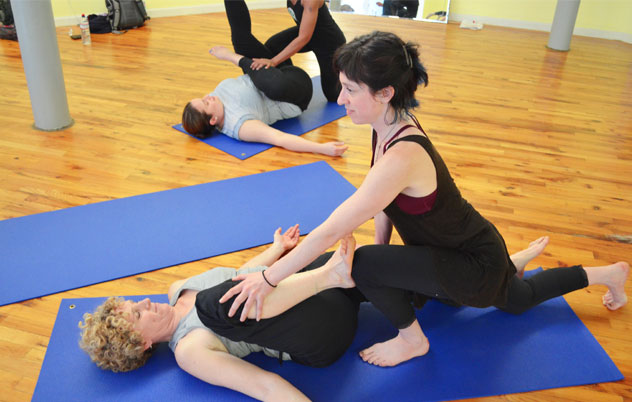
- Knee to chest (1 minute). Bend one knee and guide it toward the chest with a hand on the knee and one on the foot. Lean in only as far as your partner welcomes, hold for a few breaths, release. Repeat on the other side.
- Gentle twist (1 minute). With the knee still bent, guide it across the body while your other hand rests on the opposite shoulder. Let gravity do the work. Never force the shoulder down.
- Arms (2 minutes). Hold one wrist and walk your palm up the arm from wrist to shoulder. Finish by holding the hand and giving the arm a light, loose shake. Repeat on the other arm.
- Shoulders (1 minute). Move to kneel behind your partner's head. Place your palms on the fronts of the shoulders and press gently toward the feet on each exhale.
- Close (1 minute). Rest your hands lightly on the shoulders or the feet and breathe together for a few breaths before you let go.
How to receive well
Receiving is a skill too. A tense receiver makes the giver's job harder and gets less out of the session.
- Let your limbs be heavy. When your partner lifts a leg, resist the urge to help.
- Breathe out slowly as pressure comes in. The exhale is when muscles soften most.
- Speak up early. Saying "lighter, please" at the first wince is much better than enduring it.
- Say what feels good, too. Positive feedback helps the giver learn as much as corrections do.
Look after your own body
Givers sometimes finish a massage with sore wrists and knees. Kneel on a folded blanket, keep your wrists in line with your forearms when you press, and move your whole body closer instead of reaching. If a position strains your back, change it. A comfortable giver gives a better massage.
When not to massage
Partner massage in a yoga class is a caring exchange, not medical treatment, and it is not the same as a session with a trained Thai massage therapist. Keep it light and skip it, or ask a doctor first, when:
- the receiver is pregnant, has recently had surgery, or has a fracture or acute injury;
- there is a history of blood clots, varicose veins in the area, osteoporosis, or a heart or blood pressure condition;
- there is a fever, skin infection, rash or open wound;
- anything feels sharp, numb or tingly.
Always avoid direct pressure on the spine itself, the backs of the knees, the front of the neck and the abdomen.
Going further
If you enjoy giving as much as receiving, the Thai massage element is a good reason to explore Synergy more deeply. Our trainees learn to give a full 90-minute Thai massage, as outlined on the Partner Yoga Teacher Training Program page. For a gentler start, the last pose in Partner Yoga Poses for Beginners is a simple back press, and every Synergy class includes a short massage with a partner.