
Blog
Partner Yoga Poses for Beginners
These are the poses we come back to whenever two people are trying partner yoga for the first time. None of them needs more flexibility or strength than a gentle solo class, and all of them teach the two skills partner work depends on: sharing weight and talking to each other.
Before you start
- Find a mat or rug with room for two people lying down end to end.
- Wear clothes you can move in. Bare feet grip better than socks.
- Agree on a word or tap that means "stop," and use it without apology.
- Hold each pose for five to eight slow breaths, then switch roles if the pose is not symmetrical.
- Stretching sensation is fine; sharp, pinching or joint pain is not. Come out slowly if you feel it.
- If you have an injury, a medical condition or are pregnant, check with your doctor before trying these.
1. Back-to-back breathing
Sit cross-legged on the floor with your spines touching from the hips to the shoulders. Rest your hands on your knees and close your eyes. Notice your partner's back rising and falling, then gradually let your breathing settle into the same rhythm. Stay for a minute or two.
This is where every partner practice should begin. It costs nothing, it calms both nervous systems down, and it gets you used to the feeling of another body against yours without any pressure to perform.
2. Seated twist
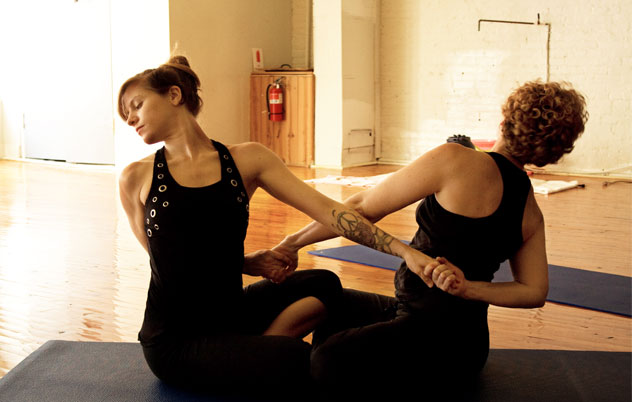
Stay back to back. Inhale and both sit up tall. As you exhale, each of you turns to your own right: place your right hand on your partner's left knee and your left hand on your own right knee. Twist from the belly first, then the ribs, then the shoulders, and only turn the head last. Hold for a few breaths, unwind slowly and repeat to the left.
Cue each other to lengthen on every inhale and turn a little further on the exhale. Twisting without length just compresses the spine.
3. Seesaw forward fold
Sit facing each other with your legs open in a wide V and the soles of your feet pressing against your partner's feet or ankles. If one of you is much less flexible, that person keeps their legs closer together and places their feet on the inside of the other's calves. Reach forward and hold each other's forearms.
One partner leans back slowly while the other folds forward from the hips, keeping the spine long. Pause, breathe, then reverse so the other partner folds. Rock gently back and forth a few times like a seesaw. The partner leaning back should never yank; the folding partner decides how far to go.
4. Double tree
Stand side by side, hips touching, and wrap your inside arms around each other's waists. Shift your weight onto your inside legs. Lift your outside feet and place each sole on the inner calf or inner thigh of the standing leg, never on the side of the knee. Bring your outside hands together in front of you, palm to palm, so you form one shared prayer. Hold, laugh if you wobble, then turn around and switch sides.
Double tree shows quickly how much easier balance becomes when you stop fighting your partner's small movements and start moving with them.
5. Back-to-back chair
Stand back to back and link elbows. Press your backs together and walk your feet forward a little at a time, bending your knees as you slide down, until you are both in a supported squat with knees roughly over ankles. Press into each other evenly. To come up, walk your feet back in and rise together on a count of three.
If one of you slips, you both slip, so talk constantly: "lower," "wait," "up on three." It is a strengthening pose and a communication exercise at the same time.
6. Double boat
Sit facing each other with knees bent and feet flat, close enough to hold hands outside your knees. Press the soles of your right feet together and slowly straighten those legs toward the ceiling, then do the same with your left feet. Lean back, keep your chests lifted and your grip steady. If straight legs are too much, keep the knees bent with shins parallel to the floor.
7. Supported child's pose
One partner kneels and folds forward into child's pose, forehead on the mat or on stacked fists. The other kneels beside them and places both palms on the lower back, one on each side of the spine, not on the spine itself. On each exhale, lean in with a little body weight, then release on the inhale. Walk the hands slowly up the muscles beside the spine and back down. Ask about pressure and adjust. Switch roles.
This last pose is a small taste of the Thai massage that closes every Synergy class. You can learn more in Thai Massage Basics for Partner Yoga Practice.
A 15-minute sequence
| Pose | Time | Focus |
|---|---|---|
| Back-to-back breathing | 2 min | Arrive, match breath |
| Seated twist | 2 min | Length before rotation |
| Seesaw forward fold | 3 min | Trusting the pull |
| Double tree | 2 min | Balancing together |
| Back-to-back chair | 2 min | Even pressure, clear counts |
| Double boat | 1 min | Core and grip |
| Supported child's pose | 3 min | Giving and receiving |
Common beginner mistakes
- Holding the breath. Concentration makes many people stop breathing. If you notice your partner going quiet and red, remind them to exhale.
- Pulling instead of offering. In stretches like the seesaw fold, the supporting partner offers resistance; the stretching partner decides the depth. Pulling someone deeper is the fastest way to lose their trust.
- Rushing the exit. Coming out of a pose is part of the pose. Release slowly and together, especially in the chair and the boat, where one person letting go suddenly tips the other over.
- Forgetting to swap. Always give both partners a turn in each role. Supporting is half of the practice, not a break from it.
- Comparing. The pair next to you may fold deeper or balance longer. It does not matter. What matters is whether the two of you are listening to each other.
What these poses teach
None of these shapes is impressive on its own. Their value is in what you practice inside them: matching another person's rhythm, giving honest feedback, adjusting to a body that is not yours. Those are the same skills that later make more dynamic work, such as therapeutic flying, feel safe. If you are curious where that leads, read Acro Yoga vs Partner Yoga.
When you are ready to practice with a teacher, a Synergy class builds on exactly these foundations, and our guide to your first partner yoga class explains what to expect.