
Blog
Words, Touch and Consent: Making Partner Yoga Welcoming for Trans Adults
Partner yoga asks more of people than a solo class does. You share weight, breath and touch with someone else, often someone you met ten minutes earlier. For trans and nonbinary adults, a new class can bring extra questions on top of the usual ones: Will the teacher use my name? Will we be paired off by gender? Who will touch me, and where? Where do I change?
Teachers and studios can answer most of those questions before anyone has to ask them. None of it requires a special program. It comes down to three things the practice already cares about: the words used in the room, the way touch is offered, and how consent is asked for and respected.
Why partner practice needs particular care
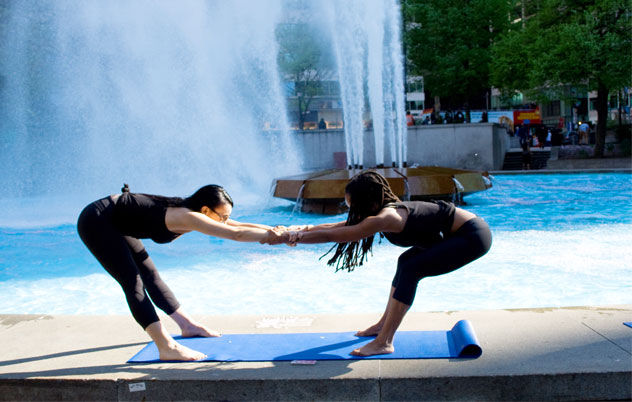
In a solo class, a student who feels uneasy can stay on their own mat and keep to themselves. Partner yoga removes that option. Contact is the point, and roles such as base and flyer bring bodies close together. For some trans people, attention to the chest, hips or pelvis can be uncomfortable, and many have had bad experiences in gyms, changing rooms and other spaces divided by gender. A class that feels relaxed to most people can feel exposed to someone who is bracing for a comment.
The good news is that the habits that make a class safe for trans students make it better for everyone: clear language, explicit consent and no assumptions about anyone's body.
Words matter: names, pronouns and cues
A welcome starts with language, often before the first class. A sign-up form can ask for the name a person uses, with pronouns as an optional field, and keep any legal name needed for payment off the attendance list. In the opening circle, teachers can invite everyone to share a name and, if they like, their pronouns. Keep it optional: some people are not out in every setting, and nobody should be put on the spot.
Cues deserve the same attention. "Ladies on this side, gentlemen over there" or "men base, women fly" sorts people by gender for no reason, since base and flyer are roles chosen by height, strength, experience and preference. "Partner A and partner B," or "base, flyer and spotter," does the same job without guessing. If you get someone's name or pronoun wrong, correct yourself briefly and carry on. Misgendering happens to careful people too, and a short correction helps far more than a long apology, which turns the moment into the student's problem.
Then there is the vocabulary people pick up elsewhere. Several words for trans women circulate mainly as porn categories and search labels, and LGBTQ media guides such as GLAAD's list of terms class them as defamatory. Those labels now sell technology as well: a slur-based search phrase like tranny ai is used to market adult AI chat apps, a reminder that a word can become a product label and still land as an insult when it is aimed at a real person. None of that language belongs on the mat. If a student uses it, even as a joke, address it promptly and privately, and make it clear that the class is for everyone in it.
A few everyday swaps make the room feel different straight away:
| Instead of | Try |
|---|---|
| "Ladies and gentlemen" | "Everyone," "friends" or simply "all right, partners" |
| "Men base, women fly" | "Choose a role for this round: base, flyer or spotter" |
| "Find a guy to work with" | "Find a partner close to your height" |
| Gendered body cues | Plain anatomy: "lift the sternum," "square the hips," "soften the knees" |
| A required gender box on the form | The name you use, optional pronouns, and a space for anything the teacher should know |
Touch and consent, made explicit
Every partner exercise depends on touch, so consent cannot be a box ticked once at registration. A few habits make it concrete:
- Ask before every assist. A teacher's adjustment is touch too. "May I place a hand on your back?" takes two seconds.
- Offer a silent way to opt out. Some studios use small cards or chips that a student turns over on the mat to show whether they want hands-on help that day.
- Name the contact points. Before a pose, describe where partners will hold each other: hands, forearms, shins, the soles of the feet. People can then choose an alternative in advance instead of freezing halfway through.
- Keep stop words simple. "More," "less," "stay" and "stop" work for every pair, as described in How Partner Yoga Builds Trust and Communication.
- Never comment on a body. Not on a chest, a voice or how someone looks. Cue the pose, not the person.
Some trans people wear a chest binder. Poses that compress the chest or call for deep breathing can be harder in one, and many trans health resources advise against binding during strenuous exercise. A teacher does not need to know who is binding. It is enough to say, for everyone, that any pose can be skipped or softened without explanation, and to offer versions that do not load the chest. The same goes for anyone recovering from surgery of any kind: students follow their surgeon's advice, and teachers offer alternatives without asking for medical details.
Pairing without assumptions
How partners are matched says a lot about a class. Let people choose where possible, or pair by role and experience rather than by gender. Give everyone the right to decline a partner change, and make sure a teacher or assistant is free to partner anyone who is left without one, so nobody ends up standing alone at the edge of the room.
Longer, closer contact calls for more choice. In Thai massage sequences, where one partner receives for several minutes, it helps to let people stay with someone they already trust, and to agree beforehand which areas are off limits. Our post on Thai massage basics explains how that part of a class usually works.
The room, the photos and the retreat
Welcome is also physical and practical. A short checklist for studios and event organizers:
- Changing space. At least one private or all-gender place to change, clearly signed, so nobody has to choose a door in front of the group.
- Dress guidance. "Clothes you can move and stretch in" covers everything a dress code needs to say.
- Photos. Ask before taking or posting pictures, and ask again before tagging anyone. Not everyone is out to every person who follows a studio online.
- Overnight events. For workshops and retreats, ask privately about rooming preferences instead of assigning rooms by assumed gender.
- A named contact. Tell students who they can speak to, privately, if something in class did not feel right.
The same values, applied with care
Synergy's philosophy names listening, compassion and understanding as essential pieces of the practice. Making partner yoga welcoming for trans adults is those same values applied with a little forethought: ask instead of assuming, offer instead of imposing, and let every student decide how they are named and how they are touched.
If you teach, these habits are worth practicing until they are automatic, and the partner yoga teacher training program covers trust-building and circle work alongside the poses themselves. If you are a student, it is perfectly reasonable to ask a studio how it handles any of this before you book, and our guide to your first partner yoga class covers the rest of what to expect.